
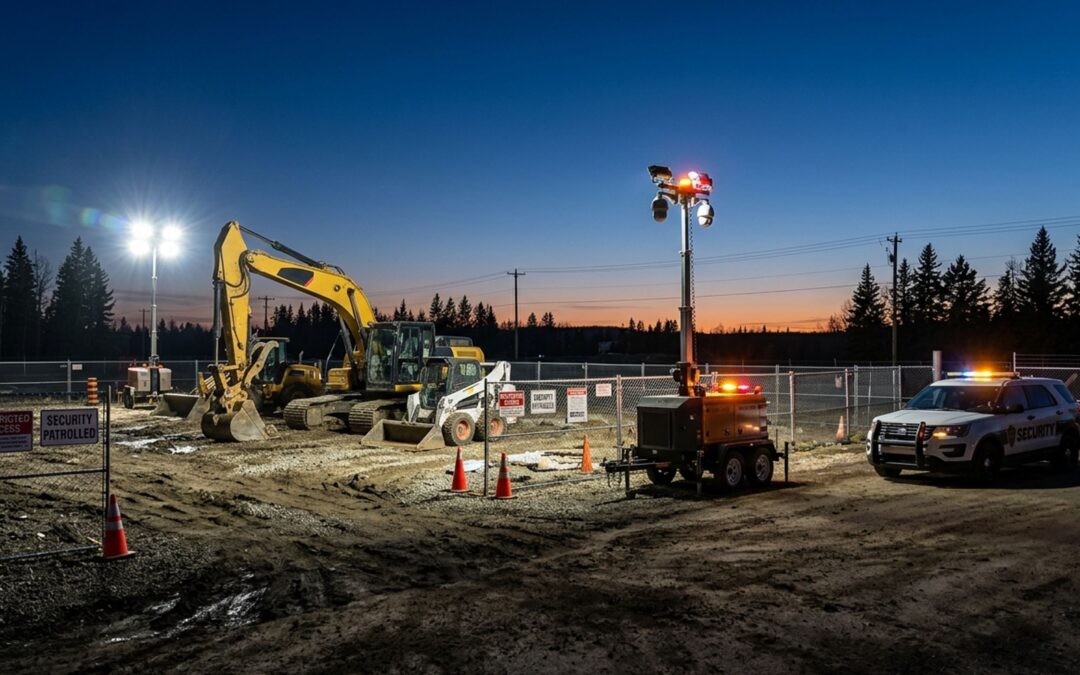
Construction equipment theft is a serious security concern for contractors, developers and site managers across Alberta. Construction sites are home to hundreds of thousands of dollars in readily accessible assets, from excavators and skid steers to generators, tools, trailers and other valuable equipment.
The loss of everyday property may be a nuisance, but the loss of construction equipment can affect an entire project. When critical equipment goes missing, work can stop, deadlines can be missed, replacement costs can increase and contractors can end up with additional expenses.
That’s why construction site security in Alberta needs to account for equipment theft as well as trespassing, vandalism, unauthorised access and other site-related risks.
Why Construction Equipment Is Targeted
Thieves often find construction equipment particularly appealing because of its high value and because many construction sites are relatively isolated.
Large projects may operate across open areas with multiple access points. Some sites may also be located away from populated areas, making it more difficult to detect unauthorised activity.
Items that are commonly targeted can include:
- Excavators
- Skid steer loaders
- Loaders
- Generators
- Compressors
- Trailers
- Power tools
- Welding equipment
- Fuel
- Building materials
- Specialised machinery
Smaller equipment and tools can be removed relatively quickly, while larger machinery requires more planning and transportation.
The risk can become even greater when equipment is left unattended overnight, on weekends, during holidays or throughout project shutdowns.
Equipment Theft Costs More Than Replacement
The financial damage from equipment theft goes beyond simply replacing the stolen machinery.
Imagine a construction crew arrives at a site and discovers that a critical machine is missing. The contractor may have to arrange a replacement immediately, rent another machine or move equipment from another project.
This can lead to:
- Project delays
- Equipment rental costs
- Higher transportation expenses
- Labour downtime
- Missed deadlines
- Insurance claims
- Increased project costs
- Loss of productivity
Sometimes the stolen equipment may also contain tools, attachments, fuel or other materials that need to be replaced.
So, in most cases, it is much more cost-effective to prevent equipment theft than to deal with its consequences afterwards.
Why Construction Sites Can Be Difficult to Secure
Construction sites are always changing.
As a project progresses, there may be new buildings, roads, utilities, fencing, storage areas, temporary offices and equipment locations. This means that a security plan that worked during one phase may not be as effective during another.
Large construction sites can also have:
- Multiple entrances and exits
- Temporary fencing
- Open boundaries
- Poorly lit areas
- Heavy machinery
- Material storage areas
- Temporary structures
- Contractor vehicles
- Delivery zones
- Isolated parts of the property
These conditions can create opportunities for unauthorised access.
For this reason, a good security plan should be reviewed as the construction project progresses rather than treated as a one-time decision.
Overnight Security: Why It’s Important
Construction sites can be particularly vulnerable after workers go home for the day.
During working hours, the property is usually busy with contractors, equipment operators, supervisors, delivery drivers and other people moving around. At night, activity drops considerably.
This can give a thief a window of opportunity to enter the site without immediately attracting attention.
Overnight security can deter unauthorised persons and provide a visible security presence when the site is otherwise unattended.
Depending on the size of the property and the level of risk involved, contractors may consider security guards, mobile patrols, access control, surveillance systems, lighting, fencing or a combination of these measures.
How Security Guards Can Protect Construction Equipment
Security guards are not simply there to stand at the entrance. A professional security guard can provide much more value to a construction site.
Security officers can monitor the property, identify suspicious activity, control access, conduct patrols and respond to security concerns.
Depending on the needs of the project, security personnel may assist with:
- Monitoring site entrances
- Checking authorised personnel
- Conducting routine patrols
- Inspecting equipment areas
- Monitoring vulnerable parts of the site
- Recording incidents
- Reporting suspicious activity
- Responding to unauthorised access
- Working with site management or emergency services when required
The exact responsibilities should be determined according to the security requirements of the construction site.
For larger or higher-risk projects, on-site guards can also be combined with other security measures to provide an additional layer of protection.
Mobile Patrols for Large Construction Sites
Not every construction site needs a security guard stationed there throughout the night.
For larger properties, remote sites or projects with multiple vulnerable areas, mobile patrol security can provide another layer of protection.
Security patrols can be scheduled to visit the property, equipment areas, access points, fencing and other vulnerable locations at different times.
Randomising patrol schedules can also make it more difficult for unauthorised individuals to know exactly when security personnel will arrive.
G4U Security offers mobile patrol security services for properties that require regular security checks and monitoring.
Access Control on Construction Sites Is Essential
One of the first steps in reducing construction equipment theft is keeping unauthorised people off the site.
Access control may include:
- Clearly marked entrances
- Secure gates
- Visitor logs
- ID checks
- Contractor verification
- Restricted equipment areas
- Key and access-card management
- Proper fencing
- After-hours access procedures
Site managers should also know who is authorised to enter the property outside normal working hours.
When several contractors and subcontractors are working on the same project, strong access-control procedures become even more important.
Equipment Identification and Tracking
Physical security should be supported by good equipment management.
Construction companies can maintain records containing:
- Equipment make and model
- Serial numbers
- Vehicle identification numbers (VINs)
- Photographs
- Ownership information
- GPS tracking data
- Storage locations
Clear identification of equipment can make reporting a theft easier and provide useful information to authorities and insurance companies.
For some equipment, GPS tracking can also provide an additional layer of protection.
However, technology should supplement physical security, not replace it.
Lighting and Site Visibility
Good lighting can go a long way towards improving security at a construction site.
Dark areas around equipment storage areas, gates, temporary buildings and site boundaries can provide places for unauthorised people to operate without being easily noticed.
Construction managers should identify areas with poor visibility and consider appropriate lighting solutions.
Lighting can work together with cameras, fencing, patrols and security personnel to create a more complete security environment.
What Happens When Construction Shutdowns Occur?
When construction is temporarily halted, the risk of equipment theft does not go away.
Projects can be put on hold because of weather, holidays, scheduling issues, material shortages or changes in project timelines.
During these periods, expensive equipment may remain on-site for days or even weeks without regular attendance from workers.
Before a shutdown, site managers should review:
- Equipment locations
- Site entry points
- Temporary fencing
- Security lighting
- Security patrol requirements
- Equipment tracking
- Emergency contacts
- Access permissions
A temporary security plan can help protect valuable assets until construction activity returns to normal.
Security at a Construction Site: A Layered Approach
There is rarely a single solution that can eliminate every security risk.
A better approach is to use multiple layers of protection based on the location, size, value of equipment, operating schedule and overall risk profile of the site.
A construction site security plan can include:
Physical security:
Fencing, gates, locks, barriers and secure equipment storage.
Human security:
Security guards, access control officers and mobile patrols.
Technology:
Cameras, alarms, GPS equipment tracking and appropriate lighting.
Procedures:
Visitor management, equipment inventories, incident reporting and emergency response procedures.
The combined effect of these measures is that unauthorised people have fewer opportunities to access the property and are more likely to be detected before a theft takes place.
Why Choose Construction Security for Your Alberta Project?
Security needs vary from project to project.
A small city project may require a different approach than a large infrastructure development in a remote location. Similarly, a site with several high-value machines may need more robust overnight protection than a site with fewer pieces of equipment.
Before choosing a security provider, contractors and site managers should consider:
- Site size and location
- Value of equipment on-site
- Number of access points
- Working hours
- Overnight risks
- Previous incidents
- Project duration
- Number of contractors and subcontractors
- Requirement for mobile patrols
- Requirement for ongoing security coverage
The objective is not simply to put a guard at the entrance. It is to build a security strategy that addresses the actual vulnerabilities of the construction site.
Conclusion
Construction equipment theft can be a significant financial and operational problem for Alberta contractors. The impact can go beyond the value of the stolen machinery to include project delays, rental costs, labour downtime, insurance costs and lost productivity.
Given the constantly changing nature of construction sites, security should be treated as an ongoing part of project management.
A combination of access control, physical security, lighting, surveillance, equipment tracking, security guards and mobile patrols can help reduce opportunities for theft and unauthorised access.
For construction companies in Alberta, making the right security investment can help protect valuable equipment and keep projects on track.
If your construction project requires professional security coverage, G4U Security offers security services for construction sites and other commercial and industrial properties throughout Alberta. Learn more about your options with G4U’s construction security services.
Frequently Asked Questions
Why is construction equipment theft a concern in Alberta?
Construction sites can contain expensive machinery, tools, fuel, trailers and building materials. When these assets are left unattended, particularly overnight or during project shutdowns, they can become targets for theft.
What construction equipment is commonly targeted?
Excavators, skid steer loaders, loaders, generators, trailers, compressors, power tools, welding equipment and other valuable machinery or materials may be targeted.
How can construction companies prevent equipment theft?
Companies can use a combination of secure fencing, controlled access, lighting, surveillance, equipment tracking, security guards and mobile patrols. The right combination depends on the site’s location, size and risk level.
Are security guards useful for construction sites?
Yes. Security guards can provide a visible deterrent while monitoring entrances, conducting patrols, identifying suspicious activity, managing access and reporting incidents.
Are mobile patrols suitable for construction sites?
Mobile patrols can be useful for large, remote or multi-area construction sites where regular security checks are required without having a guard stationed at one location continuously.
Should construction equipment have GPS tracking?
GPS tracking can provide an additional layer of protection and may help companies monitor the location of certain equipment. However, it works best when combined with physical security and appropriate site procedures.