
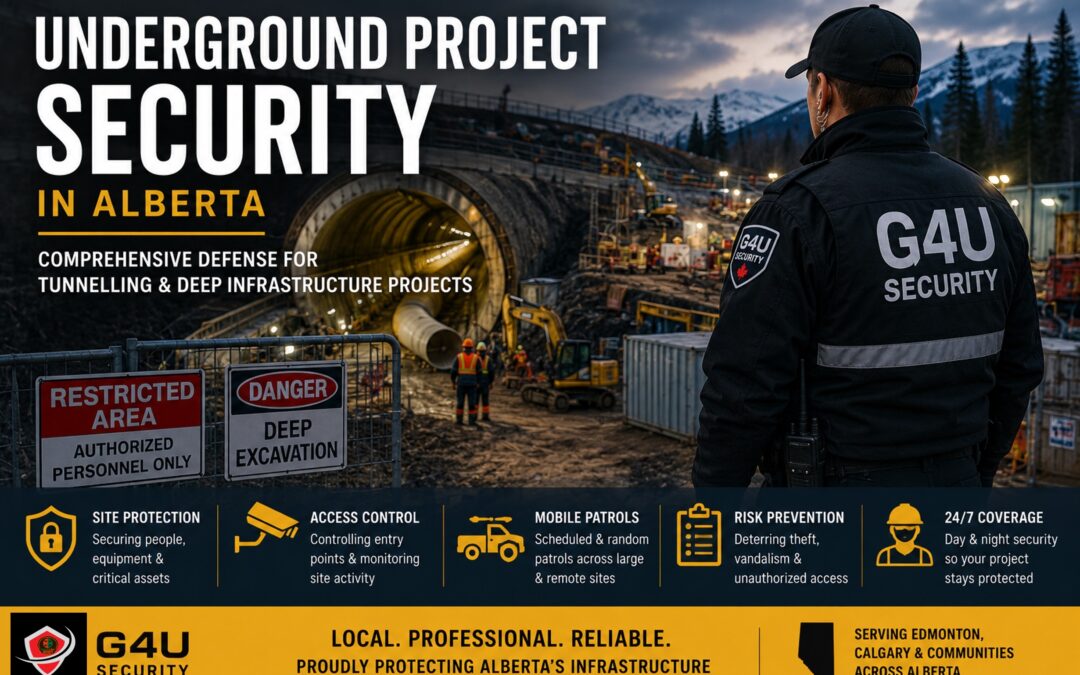
Alberta continues to invest in infrastructure that extends far beyond what is visible above ground. Pipeline corridors, utility networks, tunnelling projects, Horizontal Directional Drilling (HDD), deep excavations, and other major infrastructure projects can cover large areas and often operate in locations where traditional security measures are difficult to maintain.
These projects also involve expensive machinery, fuel, tools, materials, temporary buildings, and restricted work areas. An unsecured site can quickly turn theft or unauthorized access into a much larger operational problem.
For contractors and project managers, underground project security in Alberta must cover the entire worksite—not just the main entrance.
Why Do Underground Construction Sites Require Special Security?
Underground projects have a different security profile from a typical commercial construction site.
A tunnelling or utility project may have multiple access points spread across a large area. A pipeline project can extend for kilometres, while an HDD operation may be located close to a highway, river, railway, or other sensitive area.
Common Security Concerns Include:
- Equipment and fuel theft
- Metal and copper theft
- Unauthorized entry
- Property damage and vandalism
- Machinery damage
- Unauthorized access around shafts and excavations
- Unauthorized vehicles entering restricted areas
- Theft from laydown yards
- Disruption to construction operations
These risks can become more difficult to manage when a project operates overnight or is located in a remote part of Alberta.
Protecting Access Points, Excavations and Shafts
Open shafts, tunnel entrances, trenches, and excavation areas create both security and safety concerns.
An unauthorized person entering an active excavation or shaft could be exposed to heavy machinery, electrical equipment, unstable ground, confined work areas, or other construction hazards.
Security officers can help control access by checking workers, contractors, visitors, and deliveries before they enter restricted areas. Access records can also help site management keep track of who is on the property at any given time.
For larger projects, access control can be combined with:
- Fencing
- Locked gates
- Warning signage
- Site lighting
- Surveillance systems
- Controlled entry points
Equipment and Laydown Yard Security
Specialized equipment is essential for underground construction. After working hours, excavators, drills, loaders, generators, pumps, hydrovac equipment, trailers, fuel tanks, and tools may remain on-site.
A secure laydown yard should have controlled vehicle access and clearly defined boundaries.
Security teams can routinely inspect:
- Gates and access doors
- Perimeter fencing
- Equipment storage areas
- Fuel tanks
- Construction trailers
- Site lighting
- Machinery
- Material storage areas
- Signs of tampering or unauthorized activity
Mobile patrols can be particularly useful when a project has several separate work areas. G4U Security provides scheduled and random patrols, perimeter inspections, equipment checks, gate inspections, and documented reporting for construction sites throughout Alberta.
Mobile Patrols for Large and Remote Projects
A single security post may not be practical for a project spread across a large construction corridor.
Mobile patrol security allows officers to move between vulnerable locations and conduct inspections at scheduled or random times. This provides an active security presence without requiring a guard to remain at one location throughout an entire shift.
For linear infrastructure projects, patrol vehicles can monitor:
- Remote access roads
- Equipment areas
- Gates
- Perimeter fencing
- Material storage locations
- Other vulnerable areas
GPS-verified patrols and digital reporting can also provide project managers with records of completed inspections and reported incidents.
G4U Security offers construction and mobile patrol services that can include GPS tracking, digital reporting, photo documentation, and rapid response.
Security for HDD and Trenchless Projects
Horizontal Directional Drilling (HDD) is commonly used to install infrastructure beneath roads, waterways, and developed areas without requiring traditional open excavation along the entire route.
These work areas can contain valuable drilling equipment, pumps, generators, drilling fluids, fuel, tools, and temporary facilities.
Security coverage may include:
- Entry and exit access control
- Visitor and contractor verification
- Drill equipment protection
- Fuel and storage area inspections
- Fence and gate monitoring
- Overnight patrols
- Suspicious activity reporting
- Response to alarms or incidents
HDD sites can sometimes be relatively isolated, making security coverage outside normal working hours particularly valuable.
Technology Provides Another Layer of Protection
Security technology can make it easier to monitor large or remote construction sites.
Depending on the project, contractors may use:
- CCTV
- Motion detection
- Security lighting
- Communication systems
- GPS-tracked patrols
- Remote monitoring
These technologies can work alongside physical security personnel.
However, technology should support—not replace—proper security procedures.
A camera can detect movement, but trained personnel are still needed to determine what is happening, document the event, communicate with site management, and take the appropriate action.
Security planning for remote Alberta locations should also consider weather conditions, communications, road conditions, and vehicle access to different sections of the project.
Alberta Projects Need Flexible Security Planning
Every underground project requires a security approach suited to its specific conditions.
A pipeline project near Fort McMurray may face different challenges from a major utility tunnel in Edmonton. An HDD crossing outside Calgary may require a different approach from a remote excavation or industrial development.
G4U Security provides construction security and mobile patrol coverage in Edmonton, Calgary, Red Deer, Fort McMurray, Grande Prairie, and communities throughout Alberta, with security plans tailored to the property’s risks, operating hours, and requirements.
This flexibility is especially important for projects where the worksite changes as construction progresses.
Why Plan Security Before Work Begins?
Waiting until equipment has been stolen or a trespasser has entered the site is rarely the best time to establish security procedures.
A pre-construction security assessment can help identify:
- Vulnerable access points
- Poorly lit areas
- Equipment storage locations
- Remote sections of the property
- Areas requiring additional monitoring
Depending on the project’s requirements, a security plan can combine on-site guards, mobile patrols, access control, perimeter inspections, surveillance, and clear reporting procedures.
Protecting Alberta’s Infrastructure From the Ground Up
Building underground is challenging enough without dealing with security incidents that could have been prevented.
Whether the project involves tunnelling, pipelines, utilities, HDD, deep excavation, or major infrastructure development, protecting people, equipment, materials, and restricted areas should be part of the project plan from the outset.
G4U Security is a licensed and insured security company serving Alberta, offering construction site security, mobile patrols, access control, fire watch, and related protection services.
A comprehensive security program can help contractors manage their sites more effectively, deter unauthorized activity, and establish a clear response plan when an incident occurs.
For underground and linear infrastructure projects, security should move with the project—not remain tied to a single gate.